


High-Capacity RDF/SRFProduction: Overcoming Solid Waste Processing Bottlenecks
The global transition toward Alternative Fuels (AF) in energy-intensive industries is accelerating. However, for many cement plant operators, the promise of cement kiln co-processing is severely bottlenecked by a frustrating reality: the operational unreliability of processing high-tensile, heterogeneous municipal and industrial solid waste.

A prominent multi-facility cement plant operator recently highlighted this widespread industry pain point:
"Flexible, high-tensile textile waste and agricultural films are causing frequent mechanical seizures in our traditional primary shredders. Mechanical wrapping around the cutter shafts leads to motor overloads, soaring maintenance costs, and critical production downtime."
With multiple regional waste pre-processing hubs under management, the facility's goal was to substitute fossil coal with high-calorific Refuse-Derived Fuel (RDF) to reduce carbon emissions and optimize operational expenditures (OPEX). Instead, cascading equipment failures and unstable fuel sizing severely limited their Thermal Substitution Rate (TSR).
3 Critical Bottlenecks in Scaling Up Solid Recovered Fuel (SRF) Production
As European environmental regulations and decarbonization targets tighten, expanding Solid Recovered Fuel (SRF) capacity is a strategic priority. However, simply lining up multiple traditional single-stage shredders in series introduces three major technical risks:
1. Material Variability & High-Tensile Mechanical Wrapping
Large-scale pre-processing centers must handle between 300 to 500 tons of mixed solid waste daily. This feedstock includes Municipal Solid Waste (MSW) plastics, industrial leather, textile offcuts, post-consumer garments, and agricultural wrapping films.
The Challenge: High-tensile textiles wrap tightly around conventional shredder shafts rather than being sheared. This triggers frequent emergency shutdowns.
The Dilemma: Operators cannot reject this stream because textile waste possesses a high calorific value, making it an ideal alternative fuel source for maximizing kiln thermal efficiency.

2. Low System Uptime in Serial Processing Lines
Traditional production lines rely on a rigid serialized setup: primary shredding, magnetic separation, and secondary fine shredding. When seven or eight machines—including heavy-duty apron conveyors—are strictly interlinked, any single point of failure halts the entire line. For instance, halting a secondary shredder for blade replacement cuts the facility’s daily throughput by 50%.
3. Inconsistent Particle Sizing & Low Thermal Substitution Rate (TSR)
To ensure stable combustion, cement kilns enforce strict dimensional requirements for alternative fuels.
Oversized material (greater than 80mm) tends to clog preheater cyclones and feeding belts, risking costly kiln stoppages.
Inconsistent particle sizing reduces the specific surface area of the fuel, resulting in incomplete combustion. This inefficiency drops the actual coal replacement ratio, eliminating the financial benefits of fuel substitution.

The Technology Paradigm Shift: Harden DDS Three-Stage Shredding System
To resolve the inherent challenges of processing complex solid waste streams, Harden introduces the DDS Three-Stage Shredding System—a high-capacity alternative fuel preparation line engineered specifically for high-throughput, automated waste processing.
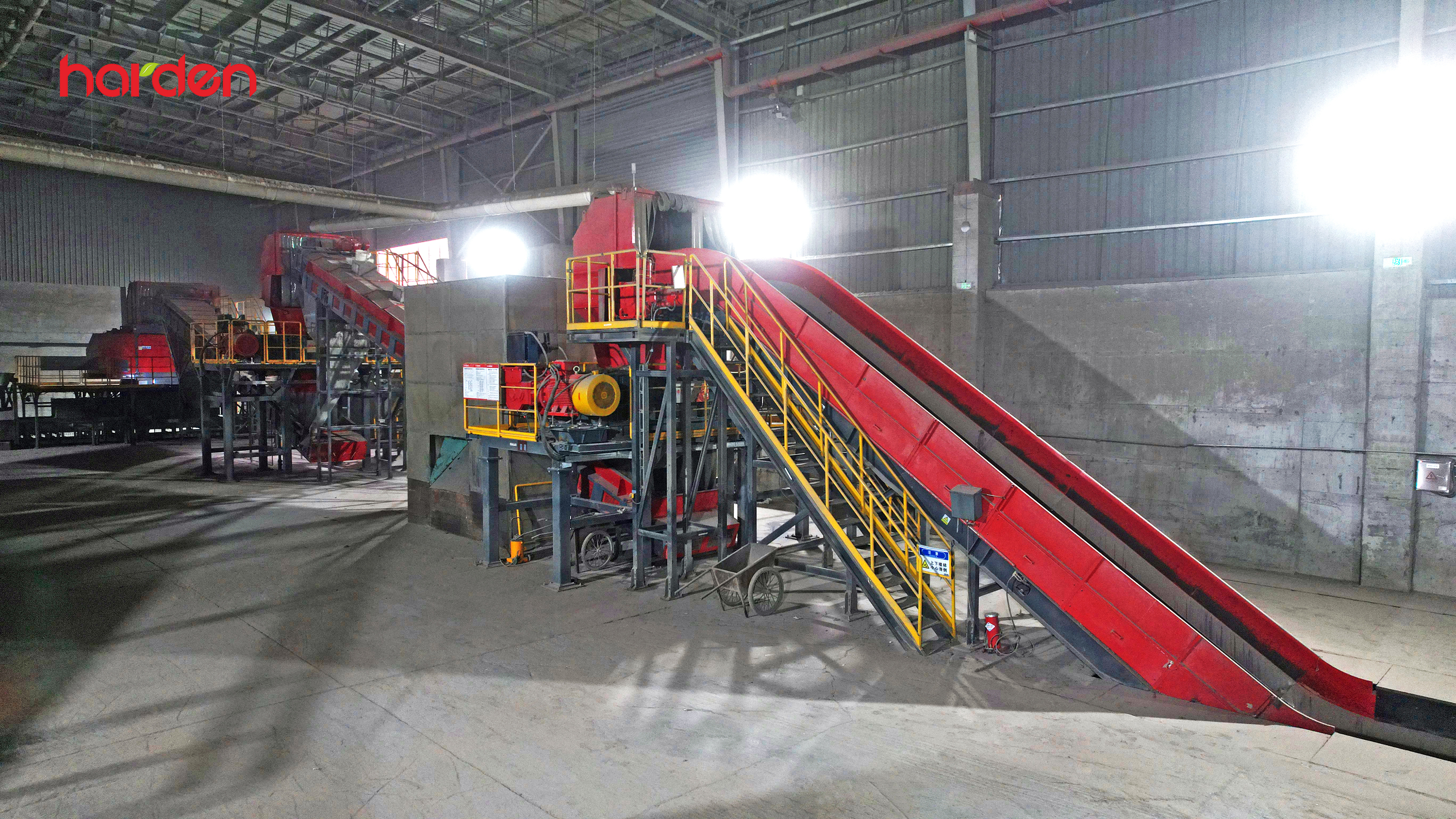
The Categorized Stratification Process
Unlike traditional serialized lines, the DDS system decouples the downsizing process into three distinct operational stages, ensuring each machine operates within its optimal parameters:
Processing Stage | Equipment Type | Primary Function | Output Size Targeting |
Stage 1: Primary Shredding | Heavy-Duty Twin-Shaft Shredder | Bulk feed breakdown, bale opening, and high-volume material acceptance without shaft jamming. | Rough sizing (coarse fraction) |
Stage 2: Secondary Shredding | Industrial Twin-Shaft Shredder | Material untangling, opening of wrapped flexible composites, and initial particle size control. | Medium fraction |
Stage 3: Fine Shredding | High-Efficiency Single-Shaft Shredder | Controlled reduction via variable bottom screen sizing tailored to exact cement kiln specifications. | Consistent under 50mm – 80mm |
Smart Energy Recovery and AI-Driven Load Balancing
The engineering core of the Harden DDS system features an advanced energy recovery loop integrated with intelligent AI load control algorithms:
Kinetic Energy Recovery System: The system automatically reclaims and redirects kinetic energy during light material feeding intervals, optimizing overall power distribution.

AI Load Optimization Loop: Through embedded smart sensors and hydraulic ram pushers, the AI continuously monitors and balances the mechanical load within the shredding chamber. If a high-volume surge occurs, the system self-adjusts the feeding speed and matches the rotor RPM dynamically.
Measurable Performance: The DDS system reduces per-ton specific energy consumption by 26% compared to conventional multi-stage lines. For an industrial processing plant handling 300 to 500 tons per day, this translates directly into significant annual utility savings and a lower carbon footprint for the processing plant itself.

Automated, Modular Architecture Designed for Optimized OPEX
True industrial value is defined by automated reliability. The Harden DDS system transitions alternative fuel preparation from a labor-intensive operation to a highly automated, data-driven process:
Single-Operator Automation: Centralized control rooms allow a single technician to monitor real-time throughput data, operational metrics, and sizing stability via a unified interface.
Predictive Maintenance & Modular Design: Engineered to minimize long-term total cost of ownership (TCO), the modular component layout reduces installation costs, extends maintenance intervals, and accelerates wear-part replacement to mitigate downtime losses.

Conclusion: Securing Competitive Advantage in the AF/SRF Market
The demand for high-quality alternative fuels like SRF, RDF, and AF across energy-intensive heavy industries (cement, steel, and power generation) is expanding rapidly. Success in this highly competitive market depends on a facility’s ability to deliver consistent, high-purity fuel with minimized operational costs.
The Harden DDS Three-Stage Shredding System delivers a proven solution with a rated capacity of 15 to 30 tons per hour (300 to 500 tons per day). By combining stratified mechanical processing, AI-driven automation, and modular durability, the DDS line effectively solves the solid waste processing bottleneck.
Contact Harden's engineering team today to optimize your waste-to-energy operations and increase your kiln's thermal substitution rate.
