


Where Is the Bottleneck in Chemical Recycling of Waste Plastics? Fine Pre-Treatment Is the First Step for Quality Improvement and Cost Reduction
Chemical recycling of waste plastics—such as pyrolysis and hydrogenation—often faces operational bottlenecks like reactor coking, catalyst poisoning, and fluctuating yields. These issues stem from improper feed quality rather than reactor design.

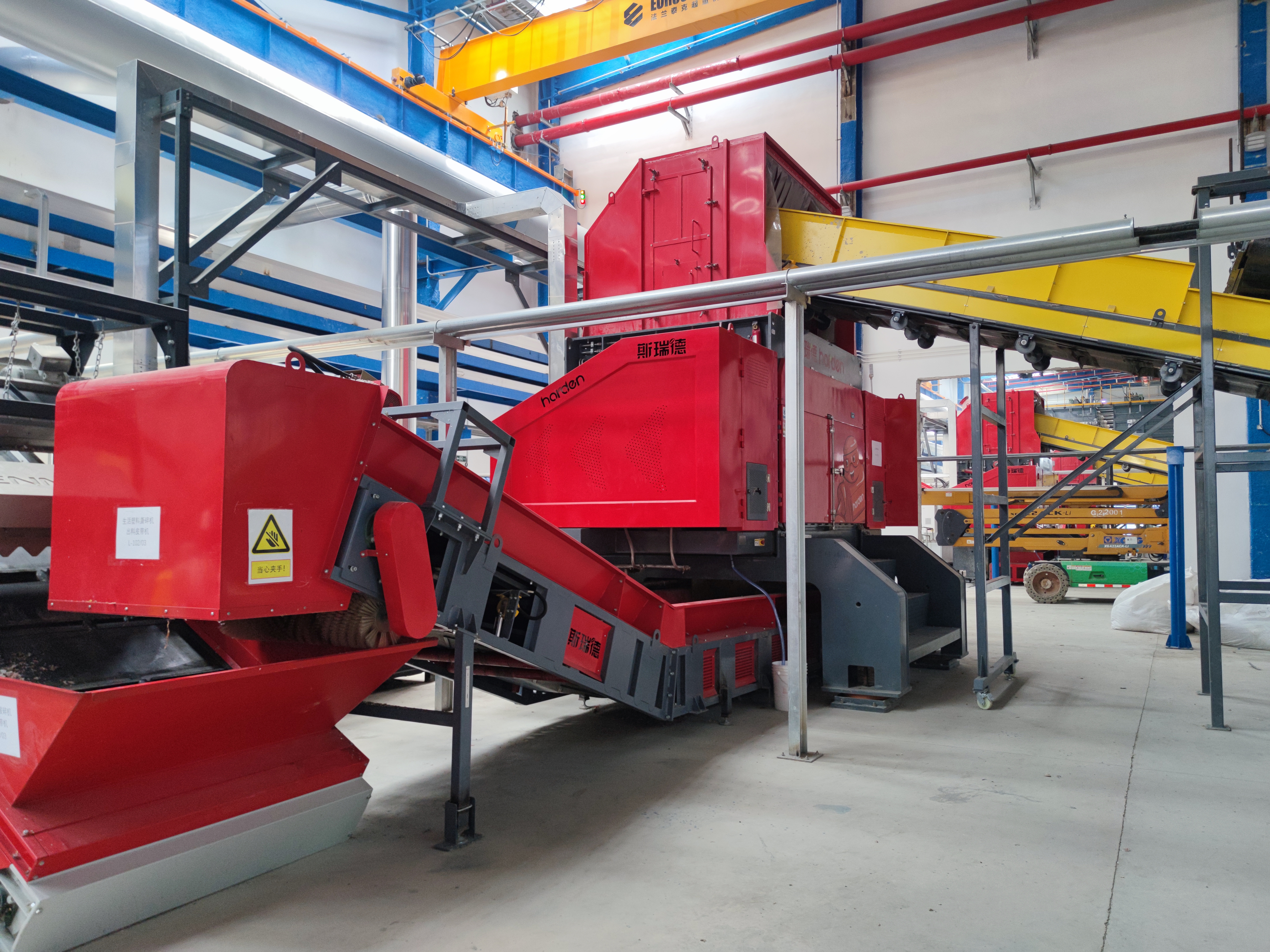
Hardens Single-Shaft Fine Shredder addresses this upstream gap by providing precise primary size reduction down to ~30 mm. Featuring adjustable shearing gaps and anti-wrapping rotor designs, the system ensures homogeneous particle sizing, thorough impurity dissociation, and optimized feed purity for chemical recycling plants.
1. What Is the Core Bottleneck in Chemical Recycling of Waste Plastics?
While chemical recycling is widely recognized as a key technology for converting low-value, mixed waste plastics into high-value chemical oils and monomers, many processing facilities face operational challenges after commissioning:
Inconsistent Feed Quality: Mixed raw materials, irregular particle sizing, and poor separation of inert impurities lead to severe reactor coking and accelerated catalyst degradation.
Impact of Coarse Shredding: Conventional primary shredding achieves volume reduction but fails to liberate plastic fractions from sand, dirt, synthetic textiles, or metals. This creates excessive loads on downstream sorting, decontamination, and feeding systems.
Chemical recycling reactors require a feed stream that is homogeneous, clean, and precisely sized. Upstream fine pre-treatment serves as the foundational safeguard to ensure continuous reactor operation and predictable product yields.

2. Technical Requirements for Chemical Recycling Feedstock
Chemical recycling processes enforce strict operational criteria on incoming plastic feedstocks:
Controlled & Uniform Particle Size: Ensures consistent heat transfer and reaction rates within pyrolysis reactors.
Liberation of Impurities: Thoroughly dissociates plastics from non-plastic fractions to enable high-efficiency air classification, electrostatic separation, and optical sorting.
Low Dust Generation: Minimizes fine dust creation to reduce raw material loss and lower explosive risk in processing workshops.
Broad Material Compatibility: Capable of processing tough, flexible films, synthetic textile fibers, and mixed rigid waste plastics.

3. Harden Single-Shaft Fine Shredder: Engineering Overview & Specifications
Summary & Key Specifications: The Harden Single-Shaft Fine Shredder is engineered specifically for chemical recycling pre-treatment. It performs fine size reduction down to approximately 30 mm in a single pass, preparing mixed plastics for downstream purification and reactor feeding.
Below is the breakdown of its core technical features and operational values:
Particle Size Control: Precise Size Reduction to ~30 mm
Operational Impact: Precision shearing structure with adjustable cutting gaps produces uniform particle sizes in a narrow spectrum, ensuring consistent reactor heating.
Anti-Wrapping Rotor Design: Optimized for Flexible & Film Plastics
Operational Impact: Custom rotor configurations prevent thin films and synthetic fibers from wrapping around the cutter shaft, reducing clogging and downtime.
System Integration: AI Smart Control & Process Automation
Operational Impact: Continuously monitors cutting loads to maintain consistent output specs, significantly improving downstream sorting efficiency.
Impurity Dissociation: High Metal & Inert Fraction Liberation
Operational Impact: Completely breaks down bulky or bundled plastics to liberate trapped non-plastic fractions, reducing downstream catalyst consumption and boosting oil/monomer yields.
4. Turnkey Pre-Treatment Workflow for Chemical Recycling
Pre-Treatment Workflow & System Logic: Harden provides complete, modular pre-treatment lines tailored to feedstock characteristics, throughput goals, and specific chemical recycling process routes (e.g., MSW-derived plastics or C&I waste plastics).
Here is the step-by-step pre-treatment workflow and its system logic:
Step 1: Primary Size Reduction & Opening
System Logic: Bales and large-format waste plastics are shredded to achieve initial volumetric reduction and open compressed materials.
Downstream Value: Prepares the material stream for uniform feeding into subsequent fine shredding units.
Step 2: Fine Shredding & Homogenization (Harden Fine Shredder)
System Logic: Material is finely shredded to ~30 mm, thoroughly liberating trapped impurities from plastic fibers and films.
Downstream Value: Produces a uniform, highly liberated material stream required for automated sorting.
Step 3: Automated Separation & Decontamination
System Logic: Integrated magnetic separators, air classifiers, and dust collection modules remove ferrous metals, heavy inert debris, and fine dust.
Downstream Value: Delivers a high-purity, low-ash feedstock to chemical reactors, protecting catalysts and preventing reactor coking.

5. Conclusion
As the industrialization of chemical plastic recycling expands, operational competitiveness depends not only on reactor efficiency but also on comprehensive pre-treatment management.
Harden provides end-to-end pre-treatment solutions—from individual fine shredders to fully integrated processing lines—helping chemical recycling facilities achieve designed production capacity, lower operational costs, and secure long-term profitability.

For detailed technical specifications, CAD layout drawings, or material testing reports, contact the Harden engineering team.
