


Phasing Out 400 Cement Kilns in 4 Years: In the Era of Capacity Consolidation, High-Quality Alternative Fuels Are the Ultimate Survival Asset
Between 2022 and 2025, China phased out nearly 400 inefficient, carbon-intensive cement clinker production lines.
This nationwide, top-down capacity shakeout is not a simple decommissioning of legacy assets. Instead, it represents a profound industrial restructuring driven by the triple pressures of supply-side reform, stringent carbon constraints, and severe market oversupply.

As inefficient small-to-medium kilns exit the market, industry consolidation is accelerating. However, the surviving large-scale cement producers face two critical challenges: soaring coal costs and escalating carbon compliance liabilities.
With the traditional playbook of "diluting costs through volume" no longer viable, high-quality Alternative Fuels (AF/RDF) have emerged as the core battleground for Tier-1 cement plants to safeguard margins, hit decarbonization targets, and build competitive differentiation.
With over a decade of expertise in solid waste recycling and turnkey alternative fuel systems, Harden provides standardized, cost-effective, and highly stable pre-treatment systems that deliver end-to-end solutions for the cement industry's green transition.
1. Decommissioning 400 Kiln Lines: Transitioning from Bulk Expansion to Low-Carbon Efficiency
The Three Irreversible Drivers Behind Capacity Phase-Out
The orderly exit of nearly 400 cement kilns over the past four years is the inevitable outcome of regulatory, market, and environmental forces:
Severe Supply-Demand Imbalance: Decades of unchecked expansion left clinker capacity far exceeding market demand, trapping the industry in low-price price wars and razor-thin margins.

Authorities have steadily eliminated inefficient kiln lines 2,500 t/d, strictly capped new capacity, and enforced replacement ratios. This tackles oversupply at the source, forcing a shift from volume-driven to margin-driven operations.
Decarbonization & Energy Consumption Controls: Accounting for 13% of China's total industrial carbon emissions, the cement sector is a primary target for carbon reduction.
National mandates require kilns operating below energy efficiency benchmarks to retrofit or close within strict deadlines.
Regulatory targets aim for a 10% alternative fuel substitution rate by 2025, scaling up to 40% by 2030. High-coal, high-emission small kilns simply cannot survive under the dual pressure of environmental audits and tightening carbon quotas.

Structural Upgrade Mandates: The updated Industrial Structure Adjustment Guidance Catalogue categorizes energy-intensive lines with poor solid waste co-processing capabilities as "restricted" or "phased out."
Regulatory frameworks no longer permit clinker production relying solely on coal. Solid waste co-processing and alternative fuel substitution rates have become mandatory baselines for green factory ratings, capacity retention, and credit support.
The New Competitive Landscape
The exit of 400 kiln lines does not mean market contraction; rather, it signals a reallocation of market share toward large-scale, compliant, low-carbon operators. Industry competition is no longer measured by kiln count or daily output. Instead, three core metrics now dictate survival:
Specific coal consumption and blended fuel costs.
Fuel substitution rates, annual carbon reductions, and carbon trading revenues.
Municipal/industrial solid waste co-processing permits and off-take capacity.
Small and mid-sized cement plants relying entirely on traditional coal have been the first to exit due to poor performance across these metrics. Conversely, market leaders like Huaxin, Conch, and Red Lion invested early in alternative fuel production lines.
Some of their facilities have achieved fuel substitution rates exceeding 60%, saving tens of thousands of tonnes of standard coal annually while generating millions in carbon trading revenue—establishing an unassailable cost barrier.
2. Harden’s High-Quality AF Systems: Engineered for Cement Kilns to Solve Two Core Industry Pain Points
European and global policies strongly encourage processing solid waste—such as textless waste, plastics, leather scraps, commercial & demolition (C&D) waste, and end-of-life tires (ELTs)—into RDF to replace raw coal.
Addressing the cement industry’s demand for alternative fuels with stable calorific value, low metallic impurities, and low-cost mass production, Harden has leveraged its 16 years of solid waste shredding expertise to develop two standardized alternative fuel preparation solutions.
Covering both pure industrial waste and complex mixed waste streams, these systems have been successfully deployed in dozens of co-processing projects for leading cement producers.
Solution 1: One-Step Shredding System — The Lightweight Choice for Mid-Sized Facilities
Engineered specifically for plants with limited floor space or smaller co-processing centers, this system completely reinvents traditional multi-stage shredding setups.
Ultra-Compact Integration: A single primary machine integrates shredding, anti-wrapping cutting, smart electronic control, and automated clearing functions.
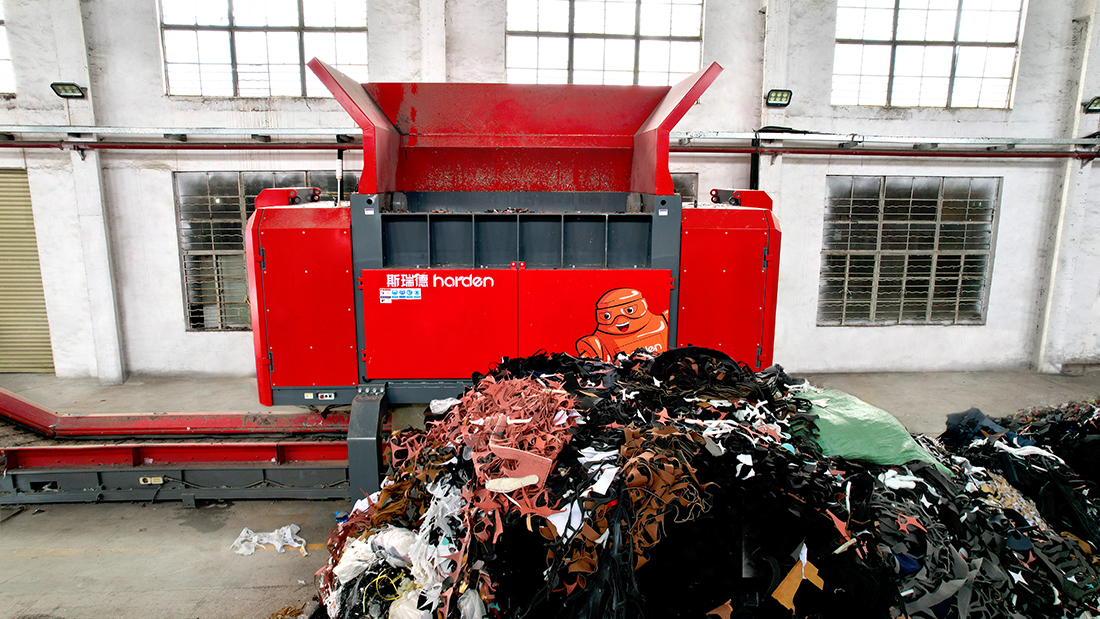
Complete with magnetic separation and conveyors, the entire line requires a footprint of just 105 m²—an 82% reduction compared to traditional lines. It eliminates the need for major civil engineering retrofits in legacy plants, drastically lowering initial CapEx and rental overheads.
Energy Efficiency & Reduced OpEx: The proprietary anti-wrapping cutting geometry prevents materials like textiles, plastics, and leather from wrapping around the blades or clogging the system, boosting production efficiency by 28%.
Variable-frequency smart drives deliver power on demand, cutting electricity consumption by 30% under equivalent output.
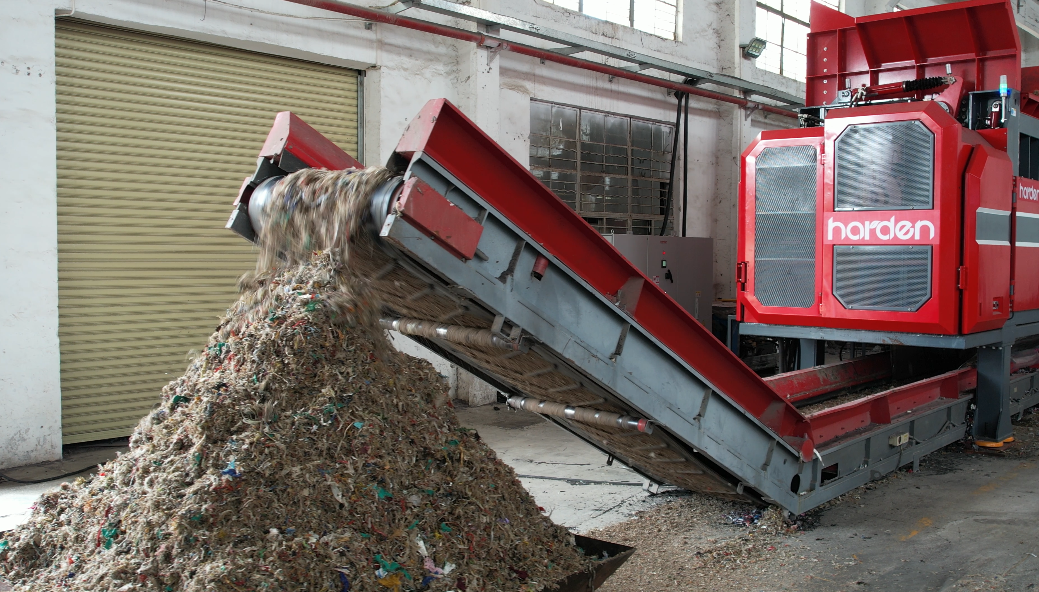
A 70,000-tonne annual RDF line can save over telemetry-equivalent €25,000 (RMB 200,000) in electricity costs alone. High-wear alloy blade sets extend wear-part lifecycles, reducing maintenance labor by 60% and lowering total cost of ownership (TCO) by 30%.
Optimized Fuel Quality for Stable Co-Processing: The output particle size is tightly controlled between 40–130 mm in a single pass.
Combined with high-precision magnetic separation, the final RDF contains virtually zero metallic impurities.

With a stable calorific value exceeding 4,500 kcal/kg, it can be fed directly into the calciner (kiln tail) at high substitution rates without disrupting the kiln temperature profile, ensuring consistent clinker quality.
Solution 2: DSWS Comprehensive Processing System — Scaled Solutions for Large Cement Parks
Designed for large-scale co-processing hubs handling over 60,000 tonnes of solid waste annually, this system processes highly complex, multi-category feedstocks like C&D waste and mixed industrial waste.
Through multiple sorting stages that lock out impurities, the final product achieves an impurity rate below 5% and a stable particle size of around 50 mm. This premium RDF allows for high-ratio co-processing at both the main burner (kiln head) and the calciner (kiln tail).

Proven Performance: Harden’s turnkey system serves Huaxin Diwei Cement in Chongqing, processing nine categories of solid waste into alternative fuels. The plant’s fossil fuel substitution rate has surpassed 60%, saving 26,600 tonnes of standard coal and reducing CO2 emissions by over 12,000 tonnes annually, delivering an economic dividend worth millions.

Conclusion
The decommissioning of nearly 400 cement kilns marks the definitive end of the industry's era of volume expansion. The cement producers that survive future market cycles will be integrated green factories that excel simultaneously in low-cost production, low-carbon emissions, and circular co-processing.
The triple pressures of coal pricing, carbon compliance, and solid waste regulations will not ease. High-quality RDF alternative fuel is no longer an optional track—it is essential survival infrastructure.
By delivering one-step, modular, and low-OpEx turnkey systems, Harden bridges the entire chain from "solid waste" to "standardized fuel" to "kiln co-processing." This empowers cement enterprises to slash costs, maximize emissions reductions, and build defensible competitive barriers in a consolidated market.
