


Why Textile Waste Is Emerging as a High-Quality Alternative Fuel for the Cement Industry

Textile Waste and Cement Decarbonization
As the cement industry accelerates decarbonization under carbon pricing schemes and net-zero commitments, increasing the Thermal Substitution Rate (TSR) has become a structural priority. At higher substitution levels, fuel quality, stability, and kiln compatibility are critical to maintaining clinker quality and operational reliability.

Within this context, well-sorted textile waste is emerging as a preferred alternative fuel compared with conventional MSW- or mixed C&I-derived RDF.
In cement applications, textile waste typically refers to post-industrial textile scraps or carefully sorted post-consumer textiles with controlled levels of PVC, metals, and other contaminants. When properly prepared, its fuel characteristics differ fundamentally from mixed waste streams.
Fuel Performance Advantages
Textile waste—particularly synthetic and blended fibers—generally delivers a net calorific value in the range of 4,000–5,500 kcal/kg, significantly higher and more stable than untreated MSW-based RDF. Consistent feedstock sources result in relatively narrow heating value fluctuations, supporting stable flame formation and steady kiln operation at elevated TSR levels.
Chlorine control is another key advantage. Well-sorted textile waste typically maintains low chlorine content (often below 0.5%), reducing the risks of preheater build-ups, excessive bypass operation, and corrosion commonly associated with mixed C&I waste.
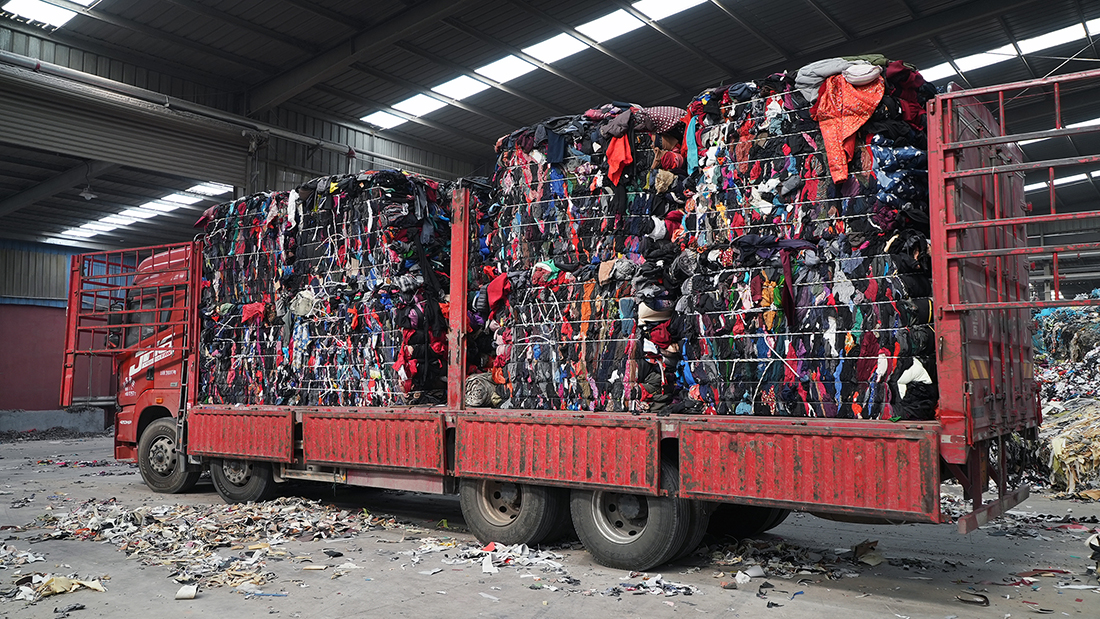
In addition, textile-derived RDF produces low ash residues, commonly below 10%. The ash composition is generally compatible with cement raw meal chemistry, allowing textile waste to contribute both thermal energy and material value through cement co-processing.
Textile RDF Processing System by Harden Machinery
Addressing the unique mechanical characteristics of textile waste, such as high tensile strength, flexibility, and a strong tendency to entangle, Harden Machinery Ltd. has developed a dedicated textile RDF alternative fuel preparation system.
Based on a modular and integrated equipment configuration, the system combines shredding, air separation, and magnetic separation into a refined processing flow. This approach effectively removes metals and non-combustible impurities from textile waste before final size reduction.
The system produces a consistently sized RDF/SRF with a particle size of approximately 50 mm, suitable for cement kiln feeding requirements. The resulting alternative fuel exhibitsa higher effective calorific value and lower thermal loss during kiln combustion.

In practical operation, the prepared textile RDF achieves an average net calorific value of 4,500–5,000 kcal/kg, equivalent to approximately one-quarter of standard coal on a substitution basis. This performance aligns well with the cement industry’s current demand for high substitution rates, enabling both cost reduction and carbon emission mitigation.
With its favorable calorific stability, low chlorine content, compatible ash chemistry, and reliable process performance, well-sorted textile waste represents a technically robust AFR option for modern cement kilns. When combined with purpose-designed preparation systems, textile-derived RDF/SRF provides a practical pathway to higher TSR, lower fuel costs, and measurable decarbonization benefits for the cement industry.
