


What Size Should Waste Plastics Be Shredded to Before Pyrolysis? How to Choose the Right Shredder

In plastic chemical recycling, shredding is more than a size-reduction process. It is a critical step in preparing feedstock to meet reactor requirements.
If plastic pieces are too large, heat transfer can become uneven, leaving some material incompletely decomposed while the outer surfaces undergo excessive thermal degradation. If the material is too fine, excessive fines can increase the risk of unwanted secondary reactions, coke formation and material loss.
Inconsistent particle size can compromise oil yield, product quality and process stability. Choosing the right shredding equipment is therefore essential for reliable pyrolysis operations.

1. What Is the Ideal Particle Size for Plastic Pyrolysis?
Typical industrial target: 10–30 mm
Patent literature and industrial studies report a wide range of particle sizes for plastic pyrolysis, from a few millimetres to several centimetres.
However, continuous industrial processes generally require more consistent feedstock preparation.
A particle size of 10–30 mm is a useful starting point for many pyrolysis applications, although the optimum depends on reactor design, feedstock composition and operating conditions. Some processes may require larger or smaller particles.
For mixed-plastic chemical recycling, particle sizes around 25–35 mm may also be suitable in certain applications. The target should always be determined by the specific process rather than treated as a universal standard.
Why does particle size matter?
Heat transfer: Smaller, more uniform particles can heat more consistently, reducing the risk of uneven thermal decomposition.
Feedstock consistency: Controlled particle size helps reduce variations in how different materials behave inside the reactor.
Catalyst contact: In catalytic pyrolysis, particle size can affect contact between the feedstock and catalyst, depending on the reactor configuration.
Process stability: Consistent feedstock preparation helps reduce operational fluctuations and supports more predictable downstream processing.
The objective is not to make the plastic as small as possible. It is to achieve the particle size required by the pyrolysis process while maintaining throughput and controlling energy consumption, equipment wear and the generation of excessive fines.

2. How to Choose a Plastic Shredder: Start with the Feedstock
Once the target particle size has been established, the next step is selecting the right shredding technology.
Different types of shredders perform different functions. The choice should depend on the physical characteristics of the waste, the required output size and the demands of the downstream process.
Twin-Shaft Shredder: For Primary Size Reduction
Twin-shaft shredders use two counter-rotating shafts with intermeshing cutting tools to tear and shear materials.

They are well suited to mixed waste plastics, including bulky items, baled materials, plastic films and materials that tend to wrap around rotating components.
Their main advantages include:
Handling mixed and irregular feedstock.
Breaking up bulky materials and opening compacted or baled waste.
Processing materials with varying shapes and sizes.
Preparing mixed plastics for subsequent screening and fine shredding.
However, a twin-shaft shredder alone may not consistently achieve the tighter particle-size distribution required by some pyrolysis processes.
For projects that require more precise particle-size control, an additional fine-shredding stage may be necessary.
Single-Shaft Shredder: For Controlled Particle Size
A single-shaft shredder is often used when a more consistent output size is required.

Harden's single-shaft shredding technology combines a rotor with stationary counter-knives and a screen to control the final particle size. The cutting gap and screen configuration can be selected according to the material and process requirements.
For plastic pyrolysis feedstock preparation, this configuration offers several advantages:
Controlled output size: Screen selection helps achieve the target particle-size range.
Consistent feedstock: More uniform output supports stable downstream processing.
Reduced oversize material: Screening limits the amount of oversized material passing through the system.
Flexible operation: Different screen configurations allow the equipment to accommodate changing feedstock specifications.
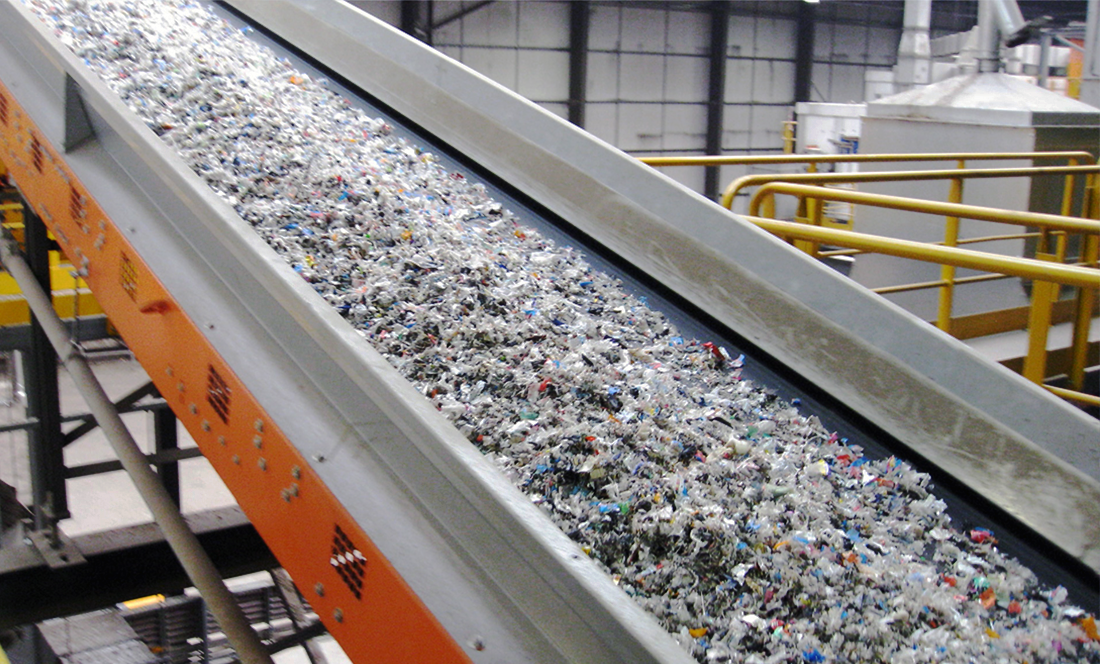
The Harden SG3000RF fine shredder is designed for high-capacity processing and fine shredding of plastic-rich waste streams.
Its adjustable cutting gap and integrated screening structure help control output particle size while reducing the need for repeated shredding. This can improve processing efficiency and help manage energy consumption and wear.
For plastic films and woven bags made from materials such as PE and PP, intelligent torque control can also help manage fluctuating loads and reduce interruptions caused by material wrapping or overloading.
The required output size should be confirmed through material testing and matched to the specifications of the downstream pyrolysis system.
3. How to Build an Effective Plastic Shredding Process
For mixed waste plastics, relying on one machine to handle every stage of size reduction may not be the most effective approach.
A two-stage process can provide greater flexibility:
Stage 1: Primary shredding
A twin-shaft shredder breaks down bulky, baled or mixed plastic waste into smaller, more manageable pieces.
Stage 2: Fine shredding and size control
A single-shaft shredder with a suitable screen reduces the material to the required particle size and helps limit oversized output.
This combination separates two distinct objectives: handling difficult incoming materials and achieving the particle size required by the pyrolysis process.
For relatively uniform feedstock, a single-shaft shredder may be sufficient, depending on the incoming material size and the required output specifications.
The final configuration should be selected according to the feedstock characteristics, target particle size, required throughput and reactor design.

Conclusion: Match the Shredder to the Pyrolysis Process
Choosing a plastic shredder is not simply a question of buying the most powerful or expensive machine. The priority is to match the equipment to the material and the requirements of the downstream process.
A twin-shaft shredder handles difficult incoming materials, while a single-shaft shredder with screening provides more precise particle-size control.
For plastic chemical recycling projects, Harden's SG3000RF fine shredder helps prepare plastic-rich feedstock with a controlled output size, supporting the requirements of downstream pyrolysis and other recycling applications.
The key is to establish the required particle size first, then select the shredding process that can achieve it consistently at the required capacity.
