


Engineering Breakdown: How Primary Shredders Resolve Key Bottlenecks in Municipal Solid Waste Pre-Treatment
Primary shredding serves as the foundational processing stage in Municipal Solid Waste (MSW) resource recovery lines.
Unsorted MSW contains high moisture, flexible synthetic textiles, and rigid bulky items that frequently lead to cutter jamming, shaft wrapping, and low throughput in conventional shredders.

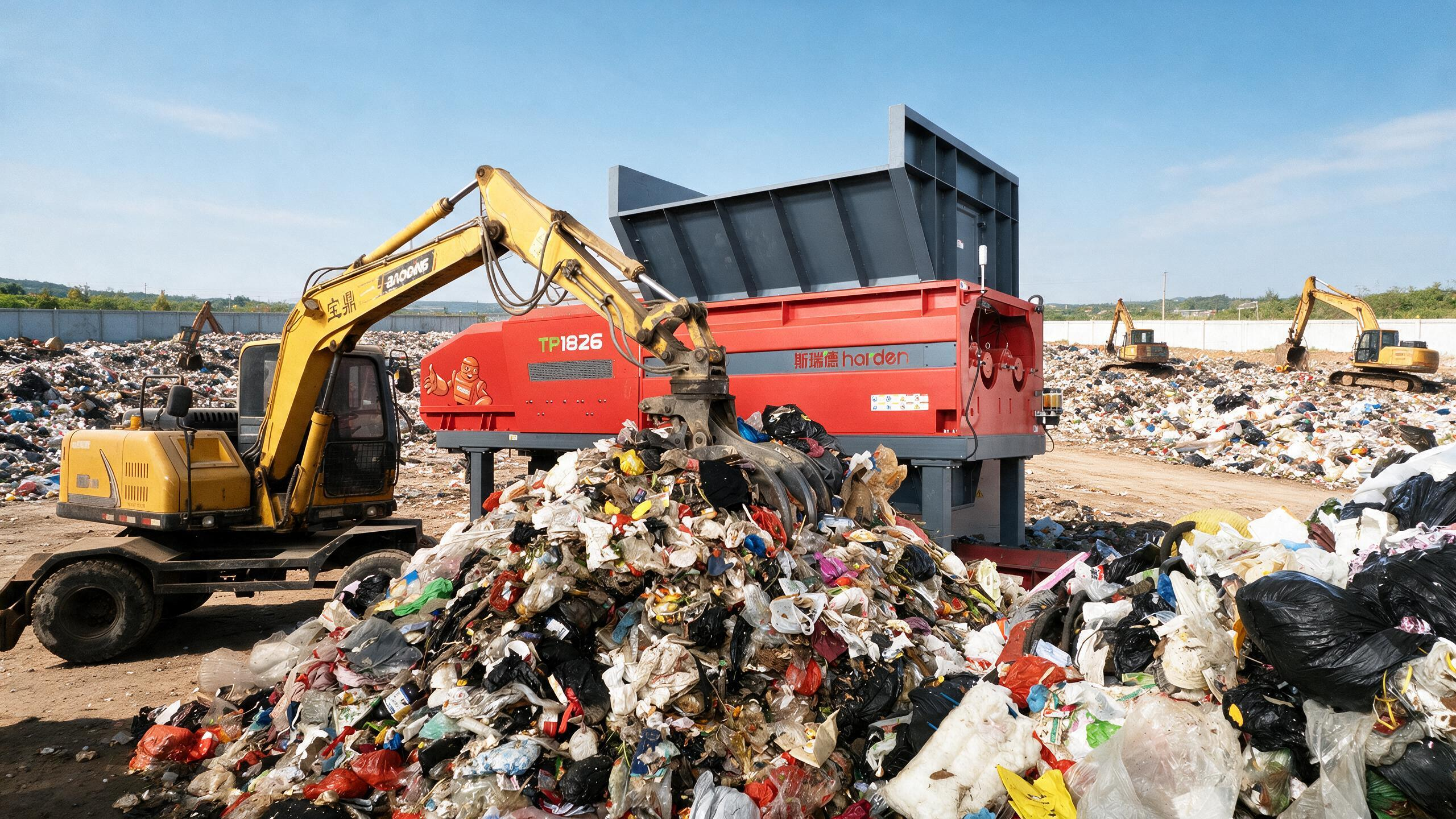
Harden's Primary Shredder Series addresses these challenges through axe-profile cutters, variable-frequency shredding programs, optimized shaft surfaces, and high-torque hydraulic direct drives, delivering throughputs up to 25–30 t/h per line for downstream RDF and sorting applications.

1. What Are the Primary Challenges in Processing Complex MSW?
Unlike source-separated waste streams, mixed Municipal Solid Waste (MSW) contains highly diverse physical characteristics that create severe operational bottlenecks for conventional primary shredders:
Variable Material Hardness: Mixed MSW streams simultaneously combine organic food waste, metallic food cans, synthetic textiles, timber, and glass packaging.
Axle Wrapping: Flexible materials—such as textiles, plastic film, synthetic cords, and ropes—wrap around cutter shafts, inducing drive stalls and motor overloading.
High Moisture & Viscosity: High organic content increases material moisture and friction, leading to severe clogging within the shredding chamber.
Frequent equipment jamming forces emergency plant shutdowns, reducing operational availability and increasing maintenance expenditures.

2. Technical Specifications & Performance Overview
Summary & Key Specifications: Harden's Primary Shredder Series incorporates a targeted engineering package—combining multi-action cutter geometries, dynamic load management, specialized shaft surface coatings, and hydraulic direct drives—to maintain continuous primary sizing of unsorted solid waste.
Below is the breakdown of its core technical specifications and operational impacts:
Cutter Geometry: Axe-Profile Multi-Action Cutters
Operational Impact: Combines shearing, tearing, splitting, and compression forces within a single cutter profile to process tough, rigid, and flexible items simultaneously.
Drive System: High-Torque Hydraulic Direct Drive (28–59 rpm)
Operational Impact: Low shaft speeds combined with high torque absorb heavy mechanical shocks without triggering motor burnout or premature tripping.
Shaft Surface Treatment: Anti-Wrapping Surface Finish
Operational Impact: Reduces material adhesion and friction along the shaft body, preventing long fibers and film from establishing a grip.
Wear Protection: Full-Coverage Wear-Resistant Liners
Operational Impact: Replaces standard hard-facing overlays on critical contact surfaces, significantly extending service life and reducing long-term OPEX.
Maintenance Feature: Modular Quick-Change Cutting Chamber
Operational Impact: Simplifies wear-part replacement, cutting overall maintenance downtime for the processing line.
3. Pre-Treatment Workflow & System Logic
Pre-Treatment Workflow & System Logic: Effective MSW recovery requires an automated, robust primary stage that prepares waste streams for downstream optical, magnetic, air, and mechanical screening.
Here is the step-by-step pre-treatment workflow and its system logic:
Step 1: Primary Sizing & Bag Opening (Harden Primary Shredder)
System Logic: Bales and bulky mixed MSW are opened and primary-shredded under dynamic, load-controlled shaft rotation.
Downstream Value: Homogenizes incoming material dimensions and prevents oversized items from causing blockages downstream.

Step 2: Load-Responsive Jam Clearance
System Logic: Integrated PLC systems monitor real-time hydraulic pressure; upon detecting a overload or wrapping trend, shaft rotation automatically reverses and adjusts frequency.
Downstream Value: Maintains continuous material discharge without requiring operator intervention or manual clearing.
Step 3: Downstream Sorting & Refinement Integration
System Logic: Sized material flows continuously to multi-disc screens, air classifiers, magnetic separators, and AI optical sorters.
Downstream Value: Optimizes separation efficiency for high-purity Recyclables, Organics, and Refuse-Derived Fuel (RDF) production.

4. Case Study: Commercial MSW Resource Recovery Line in Beijing
The effectiveness of primary shredding technology is demonstrated in municipal-scale operations, such as the comprehensive MSW resource recovery facility in Daxing District, Beijing.
Project Metrics & Operational Data
Facility Function: First-stage primary shredding and pre-treatment for mixed municipal solid waste.
Design Processing Capacity: 25 – 30 tons / hour (300 tons / day).
Downstream Integration: Feeds multi-disc screens, air classifiers, magnetic separators, and AI automated sorting units.
Environmental Impact: Diverts an estimated 300,000 tons from landfilling and 450,000 tons from incineration annually, contributing to a carbon emission reduction of approximately 1,000,000 tons of CO₂ equivalent.
5. Conclusion
Primary shredding performance establishes the overall processing capacity and uptime limit for solid waste recycling facilities.
By integrating multi-action cutter profiles, dynamic hydraulic drives, anti-wrapping shaft engineering, and automated load control, Harden's primary shredders provide a practical technical foundation for complex municipal solid waste pre-treatment lines globally.
For detailed technical specifications, CAD layout drawings, or project references, contact the Harden engineering team.
